




Will UltraGauge work with my vehicle?
The following must be true:
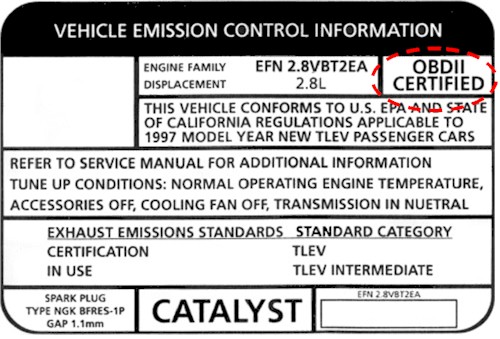
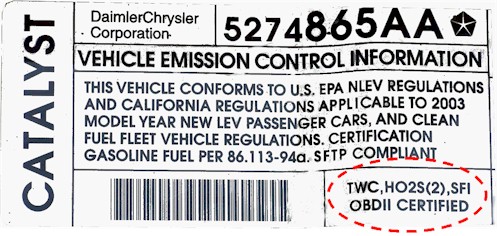
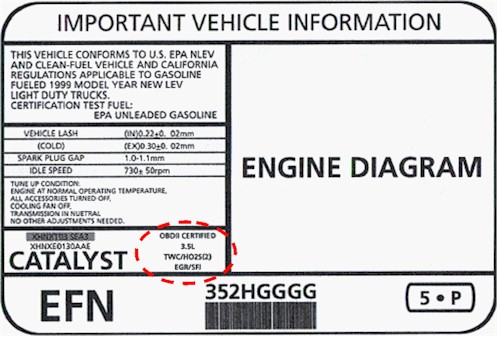
1 - "OBDII Certified" is printed on the vehicle's emission decal or in the vehicle's manual *, (See decals below)
2 - Your vehicle is not listed on our compatibility exceptions list: Compatibility Exceptions
* If you can not answer #1, please search a forum specific to your vehicle.
Which model UltraGauge is compatible with my vehicle?
ALL UltraGauge are equally compatible with ALL vehicles which are OBDII compliant
OBDII - Warning
OBDII is being replaced in a transition period starting in 2023 to 2027. In 2027 All new vehicles will use a new standard and new vehicles may no longer support OBDII. UltraGauge is currently OBDII only. If your vehicle is 2023 or newer, your vehicle may no longer support the older version of OBDII and there may be no indication of this on the vehicle's emissions label. If in doubt search a forum specific to your vehicle to determine compliance
USA Customers
UltraGauge is compatible with most (see above) 1996 and newer foreign and domestic vehicles sold in the United States. While OBD II compliance was federally mandated in the USA in 1996, some vehicle makes and models were compliant as early as 1994. Compliance is indicated on the vehicle's emissions decal located in the engine compartment. Below are examples of emission decals.
International Customers
Please confirm that your vehicle is OBDII certified. UltraGauge is only compatible with vehicles which are OBDII certified. While OBDII compliance was mandated in the USA in 1996, this is not true internationally. Most countries eventually did adopt the OBDII standard. However, vehicles sold prior to OBDII adoption may or may not be OBDII compliant. For example, Australia did not adopt the OBDII until 2006. However, many pre-2006 vehicles are compliant, many are not. If you are uncertain, please contact your vehicle's manufacturer.
Diesel Vehicles: UltraGauge may not be able to accurately estimate fuel usage. Click here to learn more
UltraGauge supports all OBDII protocols including:
| J1850 VPM | Early GM & Chrysler & very early Toyota |
| Ford | Early Ford |
| 9141 | Early Chrysler and Foreign |
| KWP 2000 | Rare, various |
| 11-bit CAN | Most 2008 and newer |
| 29-bit CAN | Most 2008 and newer Honda & Volvo |
Vehicles supported include any vehicle with an OBDII interface and includes: Passenger vehicles, SUVs, trucks, Class A, B & C RVs & Diesel vehicles
Installation is simple, simply plug UltraGauge into the vehicle's OBDII connector. The OBDII connector is typically located below the dash above the driver's foot controls. To determine the connector's location for your vehicle: OBDII locater
*Please see Compatibility Exceptions
To estimate which gauges may be available for your vehicle:
Vehicle Gauge Availability Estimator
Example OBDII Emission labels |
 |
 |
 |